Tether froze $42 million of USDT. What that means for a casino balance

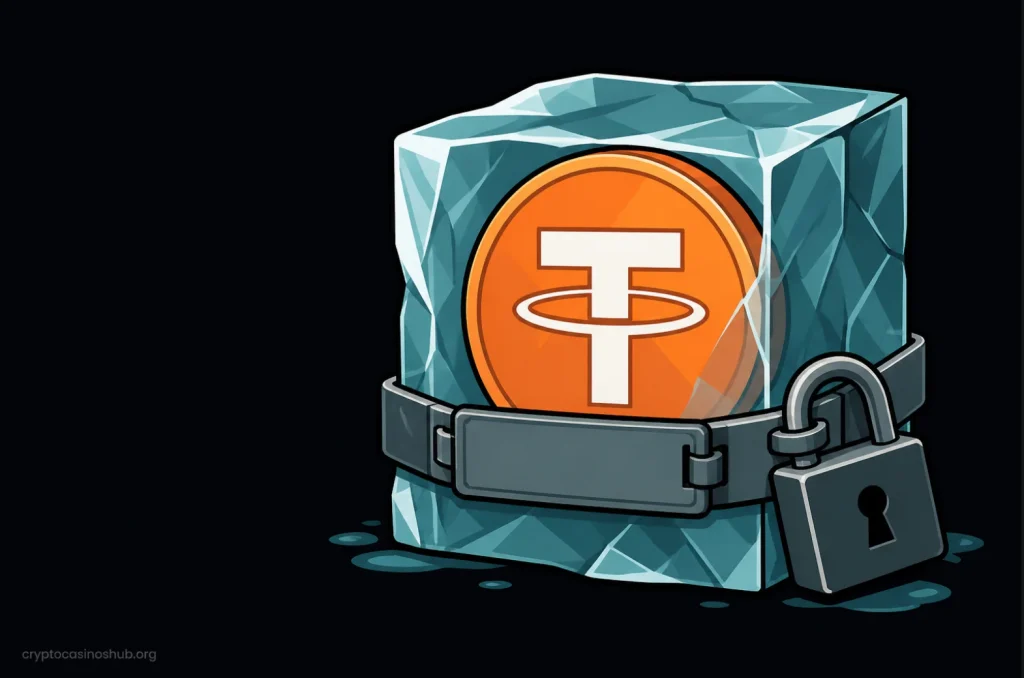
On Monday two Thai businessmen filed suit against Tether in the Southern District of New York. They say the company froze roughly $42.4 million of their USDT across ten Ethereum addresses, and that it did so at the informal request of a Homeland Security Investigations agent, with no warrant and no court order behind it. A seizure warrant did arrive, from a federal magistrate in North Carolina, but more than three months later.
The case will take years. The mechanism behind it is worth understanding this week, because it applies to every USDT balance that leaves a casino cashier, including yours.
What actually happened
Nutthawat Rukthammachalern and Natthawat Kasamvilas say they bought their USDT in ordinary secondary-market business deals. They never opened an account with Tether. They never bought tokens from the company directly. They never agreed to its terms of service. Their complaint names four separate Tether entities.
According to the filing, the addresses were blacklisted last October. The warrant that followed set out a plan for Tether to burn the restricted tokens, mint replacement USDT, and send it to a wallet the government controls. The plaintiffs argue that a warrant issued in the new year cannot reach back and authorise a freeze from the previous October, and that destroying the tokens before a final forfeiture judgment is a step too far.
Tether has not commented publicly on the claim.
The part that matters to a player
Read the paragraph above again and notice what is missing. No account. No signup. No terms accepted. The freeze did not attach to a customer relationship, because there was not one. It attached to addresses.
That is how USDT works at the contract level. Tether holds administrative functions inside the token’s smart contract that let it add an address to a blacklist on Ethereum, Tron and the other chains it issues on. Blacklisted tokens do not disappear. You can still see them sitting there on a block explorer, in your wallet, in your balance. They simply will not move. Tether can also burn them outright.
Nobody has to be your counterparty for this to happen. Nobody has to notify you first.
How common is this
Not rare, and not hidden. Tether said in April that it works with more than 340 law-enforcement agencies across 65 countries, and that the cooperation had helped freeze over $4.4 billion in assets linked to suspected criminal activity. Chief executive Paolo Ardoino put the company’s position plainly at the time: “USDT is not a safe haven for illicit activity.”
Most of that $4.4 billion is exactly what it sounds like. Fraud proceeds, sanctions evasion, the wallets at the end of a scam. The freeze power is doing the job it was built for, and a stablecoin that could not be frozen would be a worse product for everyone. That is the honest framing.
The lawsuit is about the other case: what happens when an address is caught by the machinery and the holder says the machinery was wrong. That is where the process question lives, and it is the reason this filing is worth reading rather than skipping.
Where a casino balance sits in all this
Nothing about a casino changes the mechanism. When you withdraw USDT from an operator, the coins land at an address you control, and that address carries whatever history the chain says it carries. From the token contract’s point of view there is no difference between a payout from a licensed casino and any other transfer.
Two practical consequences follow.
The first is that a stablecoin balance is not the same kind of thing as cash in a drawer. We have written before about why payouts have shifted to stablecoins, and the argument holds: a dollar peg removes the risk that your winnings shrink while you clear a bonus. But the peg is one property of the asset. Freezability is another, and it comes attached. USDC has the same capability. This is not a Tether quirk.
The second is that the address you withdraw to has a history you may not have chosen. Reusing one wallet for casino payouts, peer-to-peer trades and whatever a friend sent you last year is convenient right up until one of those inbound transfers turns out to be traceable to something ugly. Screening tools do not read intent. They read graphs.
What actually reduces your exposure
None of this argues for avoiding stablecoins. It argues for treating a withdrawal address as an asset with a reputation.
Keep casino payouts arriving at a wallet that does one job. If a fresh address only ever receives money from licensed operators and sends it to an exchange you have verified with, its graph stays boring, which is the goal.
Do not accept unknown inbound transfers to that wallet. A stranger sending you a small amount of USDT is not a gift, and the taint travels with the coins, not with the intention.
Spread the risk across assets if the balance is large. Casinos that pay in several coins let you take part of a cashout in Litecoin or Tron rather than putting the whole amount into one issuer’s contract. Our crypto converter will show you what any of it is worth in your own currency at the live rate.
Move money out rather than parking it. A casino balance is not a savings account, and neither is a hot wallet full of USDT. The casinos that pay out fastest make this easy, which is one of the reasons payout speed is worth as much attention as bonus size.
The wider point
Crypto payouts were sold on the idea that nobody stands between you and your money. For self-custodied Bitcoin that is close to true. For a token issued by a company with a blacklist function in its contract, it is not, and it never was. The trade is speed, stability and low fees in exchange for an issuer who can switch an address off.
That is a reasonable trade for most people most of the time. It is a much better trade when you know you are making it. The same instinct that makes a player check a licence before depositing, which is the habit we argue for in what makes a crypto casino trustworthy, applies to the coin in the cashier.
Regulators are moving in the same direction from the other side. Curaçao’s gaming authority now requires licensed operators to screen the wallet you deposit from and the wallet you withdraw to, and we cover what that means in the new Curaçao crypto rulebook. Between an issuer that can freeze an address and an operator that must screen one, the address is the thing under scrutiny. Worth keeping yours clean.
Sources: complaint filed 31 August 2026 in the U.S. District Court for the Southern District of New York; Tether public statements, April 2026. Reporting by Decrypt and Cointelegraph, 2 September 2026.


Comments
No comments yet. Have your say.