Nigeria and Ireland both shut out Stake. What that means for your balance

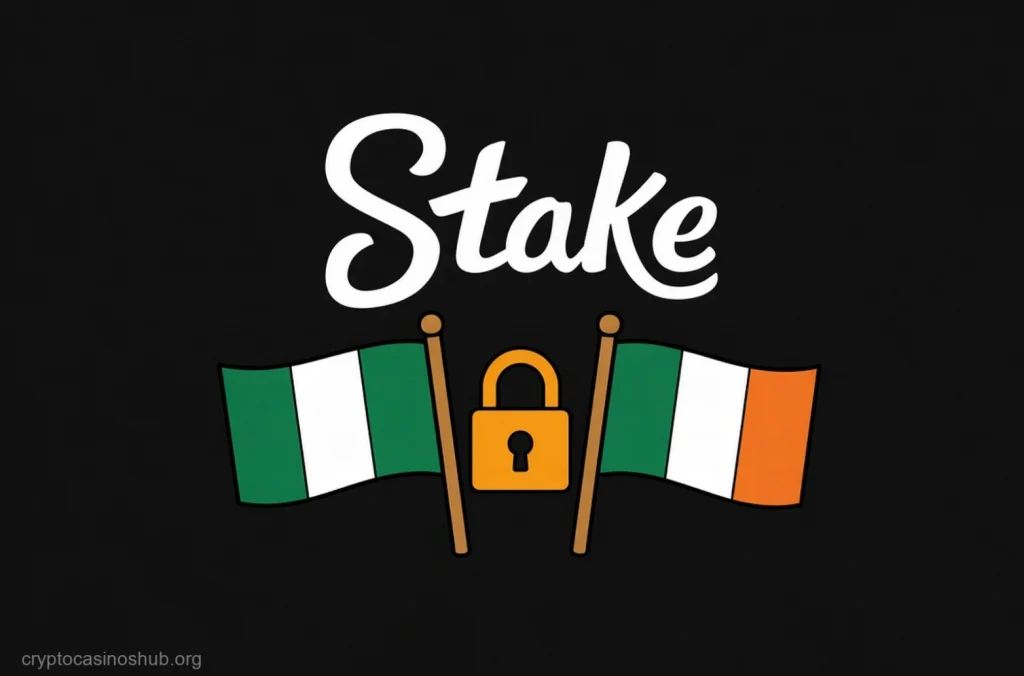
In the space of a week, the largest crypto casino in the world was shut out of two countries. Nigerian regulators declared Stake illegal across Lagos and the states aligned with them on 10 September. Around the same days, Stake switched off its own site for players in Ireland after the new Irish regulator came knocking. Neither action touched its Curacao licence, which is still live and still valid. That is the part worth understanding, because it is the part that decides whether your balance is safe.
Nigeria: declared illegal, with the banks told to cut the cord
On 10 September the Lagos State Lotteries and Gaming Authority, acting with the Federation of State Gaming Regulators of Nigeria, published a notice declaring Stake.com an unlicensed and illegal gaming operator. The declaration covers Lagos and, by the regulators’ own count, 24 member states of the federation. Some trade reporting puts FSGRN membership at 22, so treat the number as the regulators’ figure rather than a verified count. Cross River State issued its own action the following day.
The allegation is narrow and factual. Stake holds no licence from Lagos or from any member state, and according to the notice it “failed to register, declare or remit applicable monthly gaming taxes and levies despite receiving no fewer than 10 formal compliance notices over the past two years”. It sits at entry 17 on the authority’s standing list of illegal gaming companies, recorded as Medium Rara NV, a misspelling of Medium Rare N.V., the same entity named on its Curacao licence.
The legal footing is newer than the dispute. In November 2024 the Supreme Court of Nigeria decided Attorney-General of Lagos State & Ors v. Attorney-General of the Federation & Ors, striking down the National Lottery Act and confirming that gaming regulation belongs to the states rather than the federal government. An operator that once had a plausible argument about which government it answered to no longer has one.
What makes this notice different from a routine blacklisting is who else it names. The regulators said they are pursuing action against Stake, its directors, and “any payment companies, financial institutions, advertising platforms, influencers or other entities found to be facilitating its operations”. Banks, payment service providers, fintechs, media organisations and digital advertising platforms were told to run due diligence and stop facilitating unlicensed gaming.
Stake declined to comment when the trade press approached it.
Ireland: the regulator is supervising the refunds
Ireland went differently, and the difference matters.
The Gambling Regulatory Authority of Ireland is new, and it has begun enforcing the licensing regime the country introduced for remote betting. Stake geo-blocked Irish users rather than wait to be pushed, cutting access to both its casino and its sportsbook, and says it now intends to apply for an Irish licence.
The GRAI did not name Stake. Its statement referred to “operators, including two major prediction markets and a major international online gambling platform” that had geo-blocked following its intervention. The two prediction markets have been reported as Polymarket and Kalshi. The authority said other operators have also closed their Irish betting activities after contact with it, and that it has more than a hundred investigations open covering offshore sites, pubs and unlicensed bookmakers.
Then it said the thing that should interest any player reading this. The GRAI stated it is “working closely with operators who have geo-blocked to ensure that consumers in Ireland are promptly refunded all monies deposited with these operators”.
That is a regulator putting itself between a departing operator and the money it holds. Compare it with Nigeria, where the notice runs to consumer warnings, tax obligations and payment providers, and says nothing whatsoever about what happens to the balances of Nigerians who already had money on the platform. Neither regulator is wrong. They are simply answering different questions, and only one of them is answering yours.
A Curacao licence is not permission to serve you
Stake’s licence is real. We checked it when we wrote our Stake review: Medium Rare N.V., OGL/2024/1451/0918, granted 9 June 2025, listed as Active in the Curacao Gaming Authority’s public register. Nothing that happened this month changes that.
The licence was never the point. A Curacao licence authorises a company to run games of chance under Curacao law. It says nothing about whether that company may accept a player in Lagos or Limerick. Those are decisions for Nigeria and Ireland, and both have now made them.
This trips people up constantly, because casino marketing encourages it. A footer seal reading “licensed and regulated” reads like a guarantee that the site is allowed to take your money. It is a statement about the operator’s home jurisdiction, and your own country’s rules sit entirely outside it. Our guide to what actually makes a crypto casino trustworthy covers what a licence does and does not cover.
Stake knows this better than most, which is why it has been buying its way into regulated markets. It exited Britain in 2025 after a Gambling Commission investigation. It is licensed in Denmark, having acquired an operator that already held one. It entered Mexico in May and the Buenos Aires province of Argentina in June. An Irish application would continue that pattern. The company serves, by its own count, 44 million customers across 169 countries, and it is slowly discovering how many of those 169 have opinions about it.
The real story: enforcement moved to the money
Nigeria instructed banks, payment processors, fintechs, advertisers and influencers to stop dealing with Stake. Ireland worked through the operator directly and attached refunds to the exit. On 14 September, Brazil published an ordinance requiring banks to block an unauthorised operator’s accounts within 24 hours of notice, with liability extending to anyone promoting that operator.
Three jurisdictions, one week, the same instinct. Nobody is trying very hard to block domains any more. Brazil blocked more than 50,000 of them since October 2024 and still went after bank accounts, which tells you how well domain blocking works. A site moves to a new address in an afternoon. It cannot replace its banking relationships in an afternoon.
For a crypto casino this cuts in a specific way. Stake’s cashier runs on coins, which is exactly the rail a bank blocking order cannot reach. That is the argument for crypto. The counter-argument arrived in June, when the Curacao Gaming Authority told its own licensees they must screen wallets, ban mixers and segregate player funds, with the deadlines we covered in our piece on the new Curacao crypto rules. The pressure is moving onto the chain too, just more slowly.
What to do if you have a balance somewhere that goes dark
Ireland is the good case: the regulator took responsibility for making sure deposits come back. Most players in most markets do not get that. When a site geo-blocks a country, accounts there typically go read-only or vanish, and the withdrawal you meant to make next week becomes a support ticket in a queue with everyone else’s.
- If your country starts appearing in enforcement news, withdraw first and read the details afterwards. The cost of moving your balance out early is nothing. The cost of being late is a dispute.
- Complete verification before you need it. A geo-blocked account with unverified documents is the worst position to negotiate from.
- Do not keep a working balance at a casino you could not afford to lose access to overnight. Treat the cashier as a till, not a bank.
- Screenshot your balance, your transaction history and any support conversation on the day the news breaks. Our guide on what to do when a casino will not pay out explains what evidence actually helps.
What we are watching
Our Stake review still stands on what it measured: the licence, the terms, the cashier and the 2023 hot wallet theft. None of that changed this month. What changed is the map of where the company may operate, and that map now moves faster than any review can.
Three things will tell us how this ends. Whether Ireland’s refund supervision actually gets Irish players paid, which would make the GRAI a precedent worth citing. Whether Nigerian banks and payment providers comply, which is the first real test of a payment blockade against a crypto-first operator. And whether Stake’s Irish application succeeds, since the GRAI has memoranda of understanding with both the Danish regulator and the UK Gambling Commission, and the latter is the one that investigated Stake out of Britain. We will update this post as they resolve.



Comments
No comments yet. Have your say.