
How We Test and Rate Crypto Casinos
Every casino on this site carries a Trust Index from 0 to 100 and a star rating out of 5. This page explains where both numbers come from, who produces them, and how you can check the arithmetic yourself. Nothing here is a summary of the method. It is the method.
Two things are worth saying before the detail. We pay for our own accounts and our own deposits, so no operator decides what we publish about them. And every threshold below is the one the site actually applies, taken from the code that renders the scores, not a tidied-up version written for this page.
Who does the testing
One person is accountable for the reviews here: Kevin Rendel. He has spent close to 20 years in online gambling as a player, an editor and an administrator, and has run accounts at more than 120 brands. Reviews are signed with his name, his photo and the date the page was last checked, so you always know who tested a casino and when.
We do not publish anonymous reviews and we do not run text supplied by operators or their affiliate managers. If you think something on this site is wrong, the fastest way to get it fixed is to tell us.
The test, step by step
A casino is not reviewed until we have used it with our own money. The sequence below is the same every time, which is what makes two reviews comparable.
1. We open an ordinary account
No press account, no affiliate manager, no heads-up that a reviewer is coming. We register the way any player would, from a normal connection, and note what the sign-up form asks for. If documents are demanded before the first deposit rather than at cashout, that goes in the review, because it changes what a no KYC casino actually means in practice.
2. We deposit our own crypto
We fund the account with the coins the casino advertises and check three things that operators get wrong more often than you would expect. Does the deposit address match the network the site says it uses. Does the credited amount match what left our wallet. And is the advertised minimum deposit the real one. Sending USDT on the wrong network is the most common way players lose money at a crypto casino, so a site that labels its networks badly loses points for it.
3. We play across the library
We open slots and live tables from several studios and confirm the providers listed on the site are the ones actually loading. Provider lists are copied between casinos constantly, and a name in a footer is not proof of a deal. We also note what is region locked, because a library that looks large from one country can be half the size from another.
4. We claim the bonus and read the terms in full
We take the main welcome offer and read the fine print rather than the banner. Four numbers decide whether a bonus is worth taking: the wagering multiplier, what each game type contributes towards it, the maximum bet allowed while wagering, and the expiry window. A 200% match with 45x wagering and a 5 dollar bet cap is a worse offer than a small bonus with no wagering at all, and the score treats it that way. Offers with no playthrough are collected on our no wagering casinos page.
5. We withdraw and time it
This is the part that separates a casino that works from one that only looks like it does. We request a real withdrawal and time it from the moment we press the button to the moment the coins confirm in our wallet. We do not use the operator’s advertised range, we use our own clock. Anything unusual gets recorded too: a verification request that appears only at cashout, a manual review, a minimum that was not mentioned at deposit. The fastest results end up on the instant withdrawal page.
6. We ask support a real question
We send a question with an actual answer, usually about withdrawal limits or bonus terms, and record how long the reply took and whether it addressed what was asked. Copy and paste replies count against the support score.
7. We go back
Casinos change. Payout queues get longer, licences lapse, bonus terms are rewritten quietly. We retest and update the review, and the date on every page is the date of the last check, not the date it was first written.
What a payout proof is
A payout claim without evidence is just a sentence. Where we can publish the receipt, we do. Here is one from a test on Vavada.
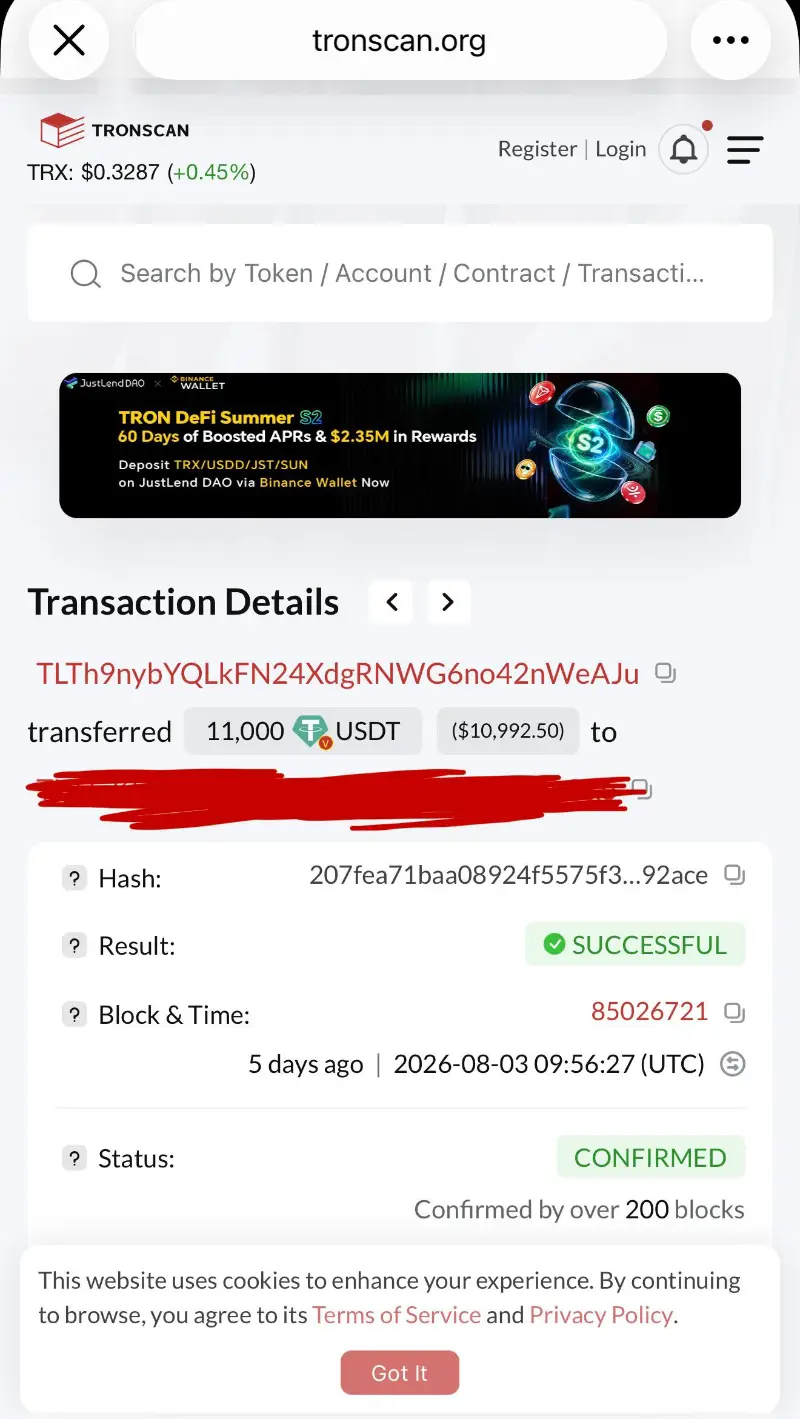
Look at what that screenshot actually is. It is not a page from the casino’s cashier, it is the transaction on a public block explorer: 11,000 USDT on the Tron network, the transaction hash, the block it was written into, the timestamp in UTC and a confirmed status. A cashier screenshot proves that a casino’s own software printed a number. A block explorer record proves the coins moved, and anyone can look up the same block and check it without taking our word for anything.
The one thing we cover up is the receiving address, which belongs to our wallet. Publishing it would put a permanent public target on an account for no benefit to the reader. Everything you need to judge the claim stays visible: the amount, the coin, the network, the time and the confirmation.
The 42 minutes in that caption is the figure that feeds the payout score, and it is our own measurement: the clock starts when we press withdraw, not when the casino’s queue decides to release the payment. Not every review carries a screenshot yet. Where there is no image, the payout time is still measured the same way rather than copied from the operator’s help page. We add proofs as casinos come up for a retest.
The Trust Index, factor by factor
Five factors, each scored from 0 to 100 and each with a fixed weight. The weights never change between casinos, so nothing can be nudged to flatter a particular brand.
Reputation, 40 percent
This is our editorial rating out of 5, multiplied by 20. It is the one part of the calculation that is judgement rather than a lookup, and it carries the most weight, because it is the only factor that captures what the whole experience was actually like. A casino that pays fast but treats support tickets as spam will show it here.
Licensing, 20 percent
A verifiable licence scores 100. No licence on record scores 45. The gap matters: it costs an unlicensed casino 11 points off its final number. A licence is not a guarantee of good behaviour, but it does mean there is a regulator to complain to, and that is worth a fifth of the score on its own.
| Licence status | Score |
|---|---|
| Licence on record and verifiable | 100 |
| No licence found | 45 |
Payout speed, 15 percent
Scored from the withdrawal time we measured, not the one advertised.
| Measured payout time | Score |
|---|---|
| Instant or a few minutes | 96 |
| Within hours | 82 |
| A day or more | 66 |
| Not established | 60 |
Bonus fairness, 15 percent
Taken from the lowest wagering requirement attached to any of the casino’s listed bonuses, because that is the best offer a player can realistically take.
| Lowest wagering requirement | Score |
|---|---|
| None, the winnings are yours | 100 |
| Up to 20x | 90 |
| 21x to 35x | 78 |
| 36x to 45x | 64 |
| Above 45x | 50 |
| No figure published | 70 |
Track record, 10 percent
How long the brand has been operating. A casino that has paid players for eight years has survived disputes, regulator attention and at least one bad quarter. A casino that launched last month has not.
| Years operating | Score |
|---|---|
| 8 years or more | 95 |
| 5 to 7 years | 85 |
| 3 to 4 years | 75 |
| 1 to 2 years | 65 |
| Under a year | 55 |
| Founding year unknown | 60 |
A worked example
Each factor score is multiplied by its weight, and the five results are added up. The table below is generated from the live data for Stake, so it always matches what the review shows.
| Factor | Score | Weight | Points |
|---|---|---|---|
| Reputation | 94 | 40% | 37.6 |
| Licensing | 100 | 20% | 20.0 |
| Payout speed | 96 | 15% | 14.4 |
| Bonus fairness | 90 | 15% | 13.5 |
| Track record | 95 | 10% | 9.5 |
| Trust Index for Stake | 95 / 100 | ||
That total puts it in the Very high band. The same breakdown appears in the sidebar of the Stake review.
What moves the number most
Because the weights are fixed, it is possible to say exactly how much any single failing costs a casino. These are the full swings between the best and worst outcome on each factor:
| Factor | Best case | Worst case | Points at stake |
|---|---|---|---|
| Reputation | 5 stars | 1 star | 32 |
| Licensing | Licensed | No licence | 11 |
| Bonus fairness | No wagering | Above 45x | 7.5 |
| Payout speed | Instant | A day or more | 4.5 |
| Track record | 8 years or more | Under a year | 4 |
The practical reading: age alone cannot sink a casino, since being brand new costs it only 4 points. Losing the licence costs nearly three times that, enough on its own to push a casino out of the top band and into the next one down.
What the final number means
| Trust Index | Label | What it means in practice |
|---|---|---|
| 90 to 100 | Very high | Licensed, pays quickly, established, and nothing in the terms caught us out. |
| 80 to 89 | High | Solid, with one soft spot, usually a slower cashout or a young brand. |
| 70 to 79 | Above average | Works, but there is a real trade off you should read about before depositing. |
| 55 to 69 | Moderate | Several weak areas at once. Deposit small if at all. |
| Below 55 | Low | Something important is missing, usually the licence. |
Every score on the site right now
This table is built from the database when the page loads. If a score changes in a review, it changes here on the next refresh.
| Casino | Trust Index | Reputation | Licensing | Payout speed | Bonus fairness | Track record |
|---|---|---|---|---|---|---|
| Duel | 96Very high | 96 | 100 | 96 | 100 | 85 |
| Riobet | 95Very high | 95 | 100 | 96 | 90 | 95 |
| Vavada | 95Very high | 98 | 100 | 88 | 90 | 95 |
| BC.Game | 95Very high | 94 | 100 | 96 | 90 | 95 |
| Stake | 95Very high | 94 | 100 | 96 | 90 | 95 |
| Spin Crypto | 91Very high | 92 | 100 | 92 | 98 | 55 |
| Mostbet | 91Very high | 84 | 100 | 96 | 90 | 95 |
| Joycasino | 90Very high | 86 | 100 | 82 | 90 | 95 |
| Casino-X | 90Very high | 86 | 100 | 82 | 90 | 95 |
| Fresh | 89High | 84 | 100 | 82 | 90 | 95 |
| Housebets | 86High | 84 | 100 | 82 | 90 | 65 |
| Flagman | 86High | 82 | 100 | 82 | 90 | 75 |
| Ramenbet | 85High | 84 | 100 | 82 | 78 | 75 |
You will notice the scores are bunched at the top, and that is worth explaining rather than hiding. This site publishes a shortlist. A casino that we cannot verify a licence for, or that fails a payout test, does not get a review at the end of it, so the published range sits high by design. The scale still does its job inside that range: the gap between an 85 and a 97 is real, and the scoreboard above shows exactly which factor caused it.
The five star ratings on each review
Alongside the Trust Index, every review carries five star ratings out of 5. These are editorial, set by the reviewer after the test, and the overall figure is the one that feeds the Reputation factor.
| Rating | What it judges |
|---|---|
| Overall | The whole experience, from sign-up to withdrawal. Feeds 40 percent of the Trust Index. |
| Trust | Licence, ownership, how the operator handles disputes and how clear the terms are. |
| Games | Size and quality of the library, which studios are present, whether provably fair games are offered. |
| Bonuses | Value of the offers once the terms are applied, not the headline percentage. |
| Support | Speed and usefulness of the replies we got, and the hours support is actually reachable. |
How we make money, and what it does not buy
Some links here are affiliate links. If you open an account through one, the casino may pay us a commission. That is how the site is funded, and you pay nothing extra for it.
What that money does not buy is worth spelling out. It does not buy a rating, a position in the list or a Trust Index point. Placement follows the score, and the score follows the test. We count clicks on outbound links so we know which pages are useful, but that number plays no part in any calculation on this page. If an operator asks us to change a review, the answer is no, and if the request comes with an offer attached, we say so in the review.
Outbound links to casinos are marked as sponsored and go through a redirect so they can be counted and updated in one place. That is standard practice and it is also required disclosure, which is why we are telling you about it here rather than in small print.
What lowers a score, and what removes a casino
Scores are not set once. These are the things that move them down:
- A payout that takes longer than our last measurement, confirmed on a retest.
- A licence that lapses or is suspended by the regulator.
- Bonus terms rewritten to add wagering, cut the maximum bet or shorten the expiry.
- Support that stops answering, or starts answering with boilerplate.
- A pattern of player reports about withheld withdrawals that we can substantiate.
A casino comes off the site entirely if it stops paying, if the licence disappears and is not replaced, or if we find the operator is misrepresenting who owns it. In that case the review is removed rather than left up with a low score, because a bad review still sends traffic.
Corrections
If a figure on this site is out of date or wrong, we want to know. Payout times and bonus terms change faster than any review schedule can keep up with, and readers spot it before we do. Send the detail to us through the contact page and include the casino and what you saw. Corrections get made to the review and the last checked date moves, so you can tell the page was actually revisited.
For more on the individual checks behind a review, every casino page carries its own breakdown in the sidebar, and you can browse the full list on the homepage.
Comments
No comments yet. Have your say.