
Curacao’s new crypto rules for casinos: what changes for players

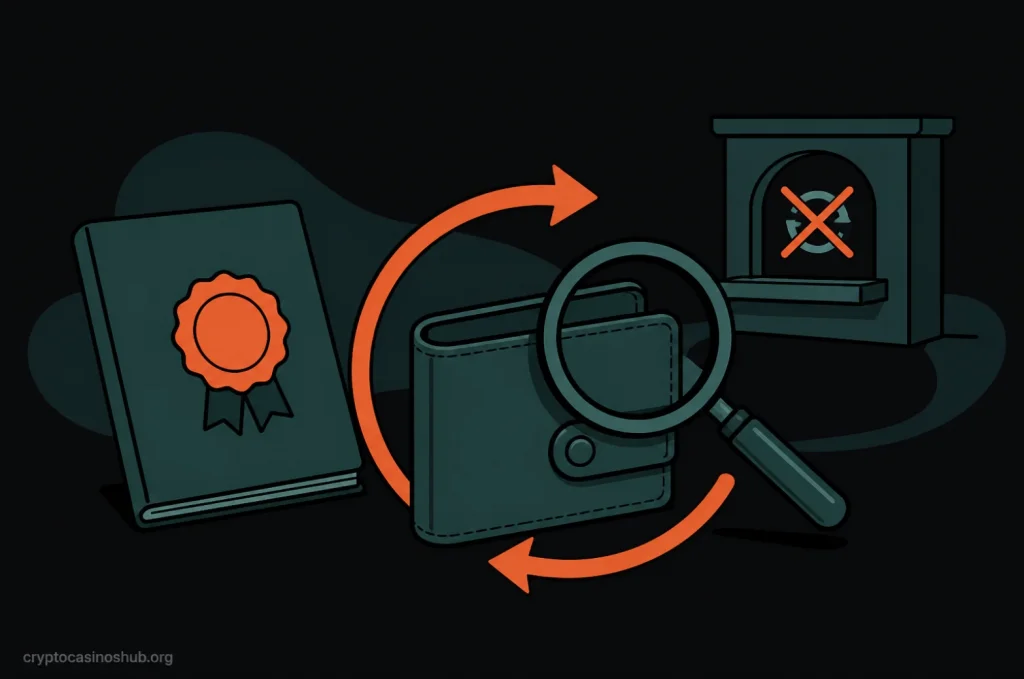
Every casino on this site holds a Curaçao licence. This month all of them hit a deadline that changes how crypto moves through a cashier, and almost none of them will announce it.
The Curaçao Gaming Authority published a crypto policy guideline for B2C licensees in June. It runs to eleven pages and covers the whole lifecycle of a coin inside a licensed operation: deposit, wagering, withdrawal, treasury. Some of it took effect immediately. The first hard deadline is September 2026, which is now.
The timetable
The rollout runs in four stages, and the regulator reserves the right to pull any of them forward if it sees a material risk.
| Stage | What is required |
|---|---|
| Immediate | Bans already in force: sanctioned wallets, mixers and tumblers, personal or owner-linked wallets, and operators acting as exchanges, payment providers or VASPs |
| September 2026 | Every licensee uploads a written crypto policy to the CGA portal, with a dated timeline for adopting the rest |
| December 2026 | Documented crypto risk assessments, due diligence on every VASP partner, wallet ownership controls, transaction monitoring procedures, staff training |
| June 2027 | Full build: wallet segregation, blockchain analytics in production, reconciliation, withdrawal whitelisting or equivalent, audit-ready records |
September is the paperwork stage, so nothing visible happens in the cashier this month. December and June are where a player notices.
Your deposit address gets read before your deposit lands
The heart of the document is a section on blockchain analytics. The CGA names Chainalysis, Elliptic and TRM Labs as the kind of tools operators typically use, does not mandate any of them, and then lists the functions a licensee has to have one way or another.
Four of those functions point straight at the player. Deposit screening, meaning your sending address is risk-scored at the moment you fund an account. Ongoing transaction monitoring across the life of the account. Source of funds tracing, documented for KYC and audit. And withdrawal screening, meaning the destination wallet is checked before the money goes out.
The regulator is blunt about who owns the result. Operators “do not need to be blockchain analysts but cannot operate blindly”, risk assessment can be outsourced, and then the line that matters: “visibility and accountability may not”. Where prohibited activity turns up, the licensee has to reject, freeze or return the funds, and report the incident.
This is the same pressure arriving from a different direction than the Tether address freeze we wrote about this week. There, the token issuer switches an address off. Here, the casino is required to look at your address before it accepts anything from it. Two different parties, one shared assumption: an address has a reputation, and somebody is reading it.
Withdrawals go back where they came from
The transaction management section sets a default that a lot of players will not expect. Withdrawals should go to the same wallet, in the same asset, as the original deposit.
The CGA accepts this is not always workable and allows two exits. A different address is permitted if it has been whitelisted, pre-screened, verified as belonging to the same customer, and put through KYC and AML checks. A different coin is permitted if the flow stays transparent and auditable, the conversion runs through a regulated VASP, and records are kept.
Read that as a direction of travel. Deposit in USDT on Tron and expect to be paid in USDT on Tron, to the address you deposited from, unless you have registered another one in advance. Withdrawal whitelisting is on the June 2027 list, so this is not a next-week change, but it is the destination.
The same section closes a loophole quietly: “Players cannot transfer amounts to each other on the platform.”
The cashier stops being an exchange desk
A separate section is titled “Not a Financial Institution”, and it is short and absolute. A licensee may accept crypto for gambling and nothing else. Operators must not convert crypto to crypto or to fiat for users, must not offer trading, swapping or exchange, and must not provide custody, transfer or wallet services outside gambling transactions. They also have to tell players plainly that they are not responsible for whatever exchange the player used to buy the coin.
If you have been using a casino cashier as a convenient way to turn one coin into another, that is the thing being switched off.
Some coins are getting pushed out
The CGA classes crypto as high risk by default and states a preference for fiat-backed regulated stablecoins where an operator has a choice. That is a regulator putting its weight behind the shift we described in stablecoins taking over casino payouts, and it makes the USDT and USDC lists more central rather than less.
Four categories get specific treatment.
Privacy coins have to be addressed in the operator’s policy because they defeat monitoring and source-of-funds work. Monero, Zcash including shielded transactions, and Dash where privacy features are used are named. So is Litecoin’s MWEB, which is worth knowing if you use Litecoin for casino payouts, because the privacy extension is optional and the regular chain is unaffected.
Wrapped and bridged assets are harder still. Licensees “shall not accept” them where the provenance of the underlying asset cannot be clearly established, and the guideline names wrapped Bitcoin as an example.
Meme coins are not banned. Operators have to categorise them on observable criteria: liquidity and volatility, governance maturity, and financial-crime risk from design features.
Pooled and omnibus wallets stay allowed as long as individual transactions can still be attributed to individual customers. Structures built to prevent that are out.
Mixers and tumblers, and any address on a sanctions list or flagged by a recognised analytics provider, are prohibited outright, and that ban is already live.
What happens to no-KYC play
The guideline says crypto is not a carve-out from anything: “The CGA’s AML policy applies equally to fiat and cryptocurrency.”
Self-custodied wallets are still accepted. But an operator has to verify that you control the wallet, using a test transaction, a signed message or an equivalent method, apply analytics to the transaction, and run enhanced due diligence where the risk score is elevated.
So the light-touch signup survives. What shrinks is the space between opening an account and being asked to prove something, which is the honest way to read every casino on our no KYC list. None of them promise anonymity at cashout, and this guideline is why we say so.
Which of our casinos this hits
All of them. Every operator we review runs on a Curaçao Gaming Authority licence under the framework that took effect in December 2024, including Vavada on a standing licence and the group behind Casino-X, Ramenbet and Joycasino, which share a single licence number.
Non-compliance is grounds for supervisory action up to suspension. That makes this a useful thing to watch: an operator that files late, or that keeps running a swap feature it is no longer allowed to run, is telling you something about how it is managed. We check licence status against the register rather than the site footer, and the method is set out in how we test and rate.
What to do about it
Deposit from a wallet you control and can prove you control, because ownership verification is now part of the rules rather than a formality.
Expect the deposit coin and the deposit address to become the default payout route. If you want to be paid somewhere else, register it early rather than at the moment you are trying to cash out.
Stop treating the cashier as a swap desk. Convert before you deposit, and use our converter to check what you are actually getting.
Keep the wallet clean. Between analytics on the operator side and freeze functions on the issuer side, your address history is now the part of the transaction under the most scrutiny.
Source: Curaçao Gaming Authority, “Crypto policy guideline for online gaming operators”, June 2026, published on the CGA portal. Quotations are from that document.



Comments
No comments yet. Have your say.