Plinko
The best published return in the building and the most expensive game in it to play for an hour. Both are true, and that is the whole game.
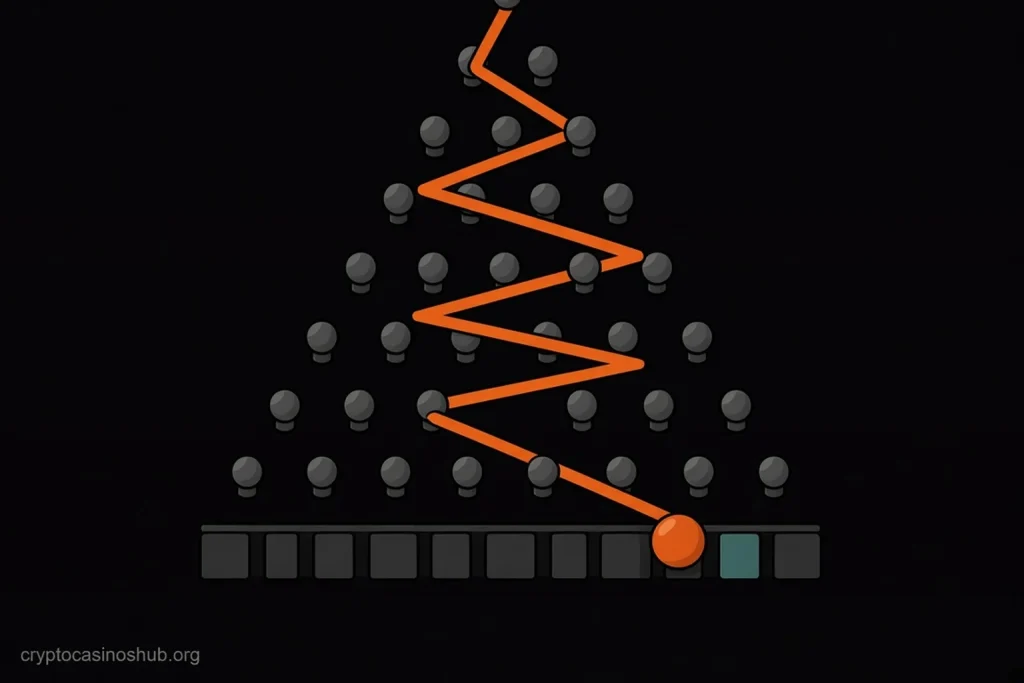
A ball drops through pegs into a multiplier slot. You set the rows and the risk, then watch.

- RTP
- 99%
- Max win
- 1,000x
- Provider
- In-house, most crypto casinos
- Counts towards wagering
- 0%
Plinko has the best published return in the building and is the most expensive game in it to play for an hour. Both of those are true at once, and holding them together is the only thing anyone needs to understand about it.
A ball drops through a triangle of pegs into one of the slots along the bottom. Each slot carries a multiplier, large at the edges, small in the middle. You set the number of rows and a risk level, press drop, and there is no decision after that. Which is exactly why autoplay will put a thousand rounds through your balance while you are reading this page.
Why a 99% game costs more than a slot
House edge is charged on turnover, not on your deposit. Plinko’s edge is a quarter of a slot’s and it generates turnover at four times the rate, which is not a coincidence and not a trick.
| Plinko, autoplay | Plinko, manual | A slot | |
|---|---|---|---|
| House edge | 1% | 1% | 4% |
| Rounds per hour | ~1,200 | ~500 | ~600 |
| Stake per round | 2 | 2 | 1 |
| Staked in an hour | 2,400 | 1,000 | 600 |
| Expected loss | 24 | 10 | 24 |
The first and last columns cost the same and one of them has a quarter of the house edge. Nothing in that table is misleading; it is the published return doing exactly what it says. The single most effective change available to a Plinko player is turning autoplay off, and it beats every risk setting and row count combined.
The same arithmetic applies to Mines and to every house original, and it is the reason a 99% label is not the bargain it looks like. The full version, including where the break-even line sits against a bonus, is on what a wagering requirement actually costs.
Rows and risk: the Plinko payout table
Two settings decide the entire paytable, and the return stays at 99% at every combination of them.
| Setting | Centre slot | Edge slot | Odds of an edge slot |
|---|---|---|---|
| 8 rows, high risk | 0.4x | 29x | 1 in 256 |
| 12 rows, high risk | 0.3x | 170x | 1 in 4,096 |
| 16 rows, low risk | 0.5x | 16x | 1 in 65,536 |
| 16 rows, normal risk | 0.3x | 110x | 1 in 65,536 |
| 16 rows, high risk | 0.2x | 1,000x | 1 in 65,536 |
The three 16-row lines share an identical right-hand column, because the physics does not care about the risk setting: reaching the outer slot means bouncing the same direction sixteen times, which is one path in 65,536 regardless. What the risk level changes is what that path pays, funded entirely by making the middle slots pay less.
So high risk at 16 rows is not a better bet than low risk. It is the same 99% with the middle returning a fifth of your stake most of the time to pay for a 1,000x you will meet about once in every sixty five thousand drops. At one drop a second that is roughly eighteen hours of continuous play for one expected hit.
Fewer rows compresses everything. Eight rows reaches the edge once in 256 drops, which sounds far friendlier until you see that the edge pays 29x rather than 1,000x. The dial is variance and nothing else.
The ball is not bouncing
Plinko is in-house code at most crypto casinos, so it is usually provably fair, and the mechanism reveals something about the game that the animation hides.
The server commits to a secret seed by publishing its hash. You supply a client seed and can change it whenever you like. Each drop hashes the pair with a nonce, and the output is the sequence of left and right bounces. The slot is therefore decided in full before the ball appears. What you watch is a replay of a number, not a simulation of a falling object.
That is precisely what makes it verifiable. Rotate your client seed, the casino reveals the old server seed, you hash it to confirm it matches the commitment, then recompute every drop you made on that pair. A genuine physics simulation could not be reproduced from a hash; this can. The step-by-step is the same one set out on the Mines page, and the underlying scheme is covered on provably fair, explained.
Which operators actually offer it: Stake, BC.Game and Duel run Plinko as an in-house original on a published hash chain. BC.Game has built it alongside Crash, Mines, Limbo, Hash Dice and Wheel since 2017. Riobet lists Plinko Pop and Plinko X Classic among 967 crash and instant titles and has no seed verification tool at all, so the name is there and the guarantee is not. More on the distinction on provably fair casinos.
Plinko strategy: three things that do not work
Waiting for the edges to be due. Drops are independent and the ball has no memory of the last thousand. A high-risk board that has returned nothing but 0.2x for four hundred drops is behaving exactly as specified, and its next drop has the same one-in-65,536 chance as the first.
Switching risk level to chase a loss. Every combination returns 99%, so moving between them changes the length of the swings and not their direction.
Martingale on autoplay, which is the one that does real damage. The scripts circulating for this double the stake after each drop below 1x, and on high risk at 16 rows that is most drops. The sequence needs a balance and a table limit that nobody has, and the autoplay will find the losing run in minutes rather than hours precisely because the game is so fast.
What does work is unglamorous: manual drops, or autoplay with a stop-on-loss set before you start. It does not improve the odds. It ends the session at a number you chose rather than at a number the game chose.
Plinko and bonuses
Plinko is on the excluded list at more casinos than any other game in this category, and the combination that puts it there is obvious once stated: a 1% edge and a one-second round.
At Stake it is named explicitly among the 22 Originals blocked by taking a deposit bonus, alongside Dice, Mines, Crash, Limbo, Keno and Hilo, on top of 47 studios and 678 third-party titles. Riobet takes the better-documented approach and publishes a per-title contribution on its Game Rules page, sortable, running from 0% on its house crash game Astronaut to 100% on titles like Dogmasons. Check the number before you claim, not after.
The workable arrangement is the same as for Mines: play it with your own money and let the turnover count towards rakeback or a VIP tier, which is usually measured in money staked rather than in expected loss, or take an offer with no playthrough from the no wagering casinos page.
Frequently asked questions
What is the RTP of Plinko?
Which Plinko risk level is best?
What are the odds of hitting 1,000x in Plinko?
Why does Plinko cost more than a slot if the RTP is higher?
Is Plinko provably fair?
Does the ball actually bounce randomly?
Does Plinko count towards wagering?
Pros
- 99%, level with Mines and the best on offer anywhere
- Rows and risk give you the payout shape you want, at the same return
- Provably fair, and the slot is fixed before the animation starts
- No decision after the drop, so there is nothing to misplay
Cons
- Autoplay produces around 1,200 rounds an hour, more than any other game
- Costs the same per hour as a slot with four times the house edge
- The 1,000x needs one exact path in 65,536, about eighteen hours of drops
- Named on Stake's bonus exclusion list, and excluded almost everywhere else