Mines
Twenty five tiles and a dial no other casino game gives you. 99% at every bomb count, and the first title struck out of every bonus.
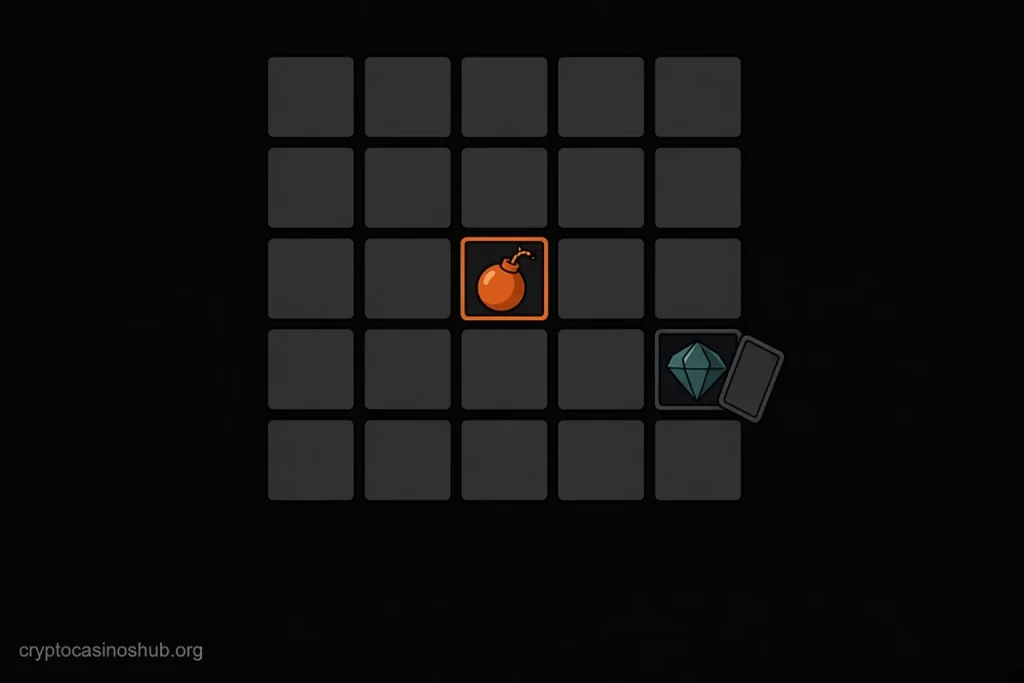
A 5x5 grid, you choose the number of bombs, open tiles and collect before you find one.

- RTP
- 99%
- Max win
- 24.75x per tile
- Provider
- In-house, most crypto casinos
- Counts towards wagering
- 0%
Mines gives you a dial no other casino game does. Twenty five tiles, you decide how many hide a bomb, then open tiles one at a time and collect whenever you like. One bomb or twenty four, the return is the same 99%. All you are choosing is how long you wait and how hard it hits.
That 99% makes it one of the two cheapest games in a crypto casino. It also makes it the first thing struck out of every bonus, and the thing an operator has the most reason to quietly run at a worse number. Both of those are covered below, with the specific casinos and clauses.
Mines payout table: what each bomb count actually pays
With one bomb on the grid the first tile is safe 24 times in 25 and pays about 1.03x. With 24 bombs there is a single safe tile, you find it one time in 25, and it pays 24.75x. Both settings return 99%.
| Bombs | 1 tile | 3 tiles | 5 tiles | Chance of reaching 5 tiles |
|---|---|---|---|---|
| 1 | 1.03x | 1.12x | 1.24x | 80% |
| 3 | 1.12x | 1.45x | 1.94x | 51% |
| 5 | 1.24x | 1.94x | 3.23x | 31% |
| 10 | 1.65x | 4.95x | 18.97x | 5.2% |
| 15 | 2.48x | 17.34x | 176.8x | 0.56% |
| 24 | 24.75x | n/a | n/a | n/a |
Read the last two columns together and the whole game falls out. Five tiles at three bombs pays under 2x and lands half the time. Five tiles at fifteen bombs pays 176x and lands once in 180 attempts. Multiply payout by probability in any row and you get 0.99 of your stake. There is no row that is better value than another row.
This is worth labouring because the interface argues the opposite. A 4.95x sitting on the collect button after three safe tiles at ten bombs feels like something you earned by judging the moment. It is the exact price of a risk that was fully paid for three clicks ago. The button is showing you a receipt, not a reward.
99% is not guaranteed, and the operator says so
Mines is not a studio product. It is in-house code, which is why it can be provably fair, and it is also why the house edge is whatever the operator decided to compile. A Mines running at 97% is pixel-identical to one at 99%.
The Stake terms are unusually direct about where that leaves you. They reserve the right to adjust the house edge at their sole discretion and without prior notice, and then add that in the event of a discrepancy between Stake’s house edge and the RTP displayed in-game you should contact support, and that they accept no liability whatsoever should you place a wager in reliance on the displayed figure. Read that twice. The number printed inside the game is not a number the operator stands behind.
Stake is not the villain here for publishing it; nearly everyone reserves the same right and most simply do not say so. The practical rule is that the edge belongs in the game’s own info panel or the fairness section of your account, as a number, and a casino that prints it nowhere has answered the question.
Where you will find a real one, from our own testing: Stake publishes the edge per Original and the outcomes are seed-verifiable. BC.Game runs Mines as part of an in-house set alongside Crash, Plinko, Limbo, Hash Dice and Wheel, all on a published hash chain. Duel runs provably fair originals with the same structure. Riobet carries Mines in two variants inside a 967-title crash shelf, but has no seed verification tool anywhere on the site, so there it is an ordinary RNG game wearing the name.
How to verify a Mines round
This is the part that separates Mines from a slot, and it takes about two minutes the first time.
- Open the fairness or seed panel in your account. Before you play, the server has committed to a secret seed by showing you its SHA-256 hash. Copy that hash somewhere outside the casino.
- Set your own client seed to anything you like. This is the half the casino cannot control, and it is the reason the scheme works.
- Play. Each round hashes the server seed, your client seed and a nonce that steps once per round; the output orders the 25 tiles and the first N become bombs.
- Rotate your client seed. Rotating forces the casino to reveal the old server seed.
- Hash the revealed seed and check it matches the hash you copied at step one. If it does, the seed existed before your first bet and could not have been chosen to suit your results.
- Re-run the round function with that seed, your client seed and the nonce for any round you played, and confirm the bomb positions match your history. Operators doing this properly publish the script.
This is a stronger guarantee than Aviator offers, because the client seed is yours to rotate rather than pooled between the first three players in the round. It is also strictly narrower than people assume: it proves a round was not altered after the fact. It says nothing about whether the casino pays, which is a separate test and the one we run with real money on the instant withdrawal page. The mechanics in more depth are on provably fair, explained.
Mines strategy: what works and what does not
Tile patterns do nothing. Corners, the centre, a diagonal, the same four tiles every round. Bomb positions come out of a hash computed before you touch the grid, and no square is likelier than another. A pattern that has worked twenty times has told you nothing about the twenty first.
Raising the bomb count after a loss is the Mines version of doubling and fails identically: the losing run that breaks it needs a bankroll and a table limit you do not have. Lowering it after a loss does nothing either, because rounds are independent.
The one thing that genuinely changes your evening is turnover, and Mines is built to produce it. A round takes a few seconds, which is four hundred rounds in an hour without hurrying. At 10 a round that is 4,000 staked and about 40 given up on a 99% game, before variance. The percentage is excellent. The rate is what costs money, and the stake per round is the only number on the screen you fully control.
Mines and bonuses: excluded almost everywhere
A 1% edge gives an operator nothing to fund an offer with, so Mines is usually the first title on the exclusion list rather than merely weighted down.
At Stake, taking a deposit bonus locks you out of 47 studios and 678 individual titles plus 22 of the Originals, and the named list includes Dice, Plinko, Mines, Crash, Limbo, Keno and Hilo. Separately, Stake weights bonus wagering by house edge rather than by money staked, calibrated to a 4% game, so where a low-edge title does count it credits about $0.25 per $1 wagered. Two different mechanisms, both pointing the same way.
There is one place the thin edge works for you rather than against. VIP progress is normally measured in money staked rather than in expected loss, so the same Originals that clear a bonus slowly climb the VIP ladder at full speed. If you are going to play Mines at volume anyway, doing it without a bonus and letting it count towards rakeback or a VIP tier is the arrangement that makes sense. Duel pays 50% rakeback as cash on slot bets, which is the same idea reached from the other direction.
Otherwise: play it with your own money, or take an offer with no playthrough attached from the no wagering casinos page. The full arithmetic of why a 1% game and a bonus cannot coexist is on what a wagering requirement actually costs.
Frequently asked questions
What is the RTP of Mines?
Does the number of bombs change the RTP in Mines?
How many mines should I set?
Is there a pattern to where the bombs are?
How do I check a Mines round was fair?
What is the biggest single payout in Mines?
Does Mines count towards a bonus?
Which casinos have provably fair Mines?
Pros
- 99%, the best return in most lobbies alongside Plinko
- The bomb count is a variance dial no other casino game offers
- Provably fair with a client seed that is yours to rotate
- Turnover still counts in full towards rakeback and VIP tiers
Cons
- The edge is the operator's, and Stake disclaims the RTP shown in-game
- Named on Stake's bonus exclusion list with Dice, Plinko, Crash and Limbo
- The collect button reads like a reward and is only a receipt
- Four hundred rounds an hour turns a 1% edge into a real number