
The 25x rule: what a wagering requirement actually costs you

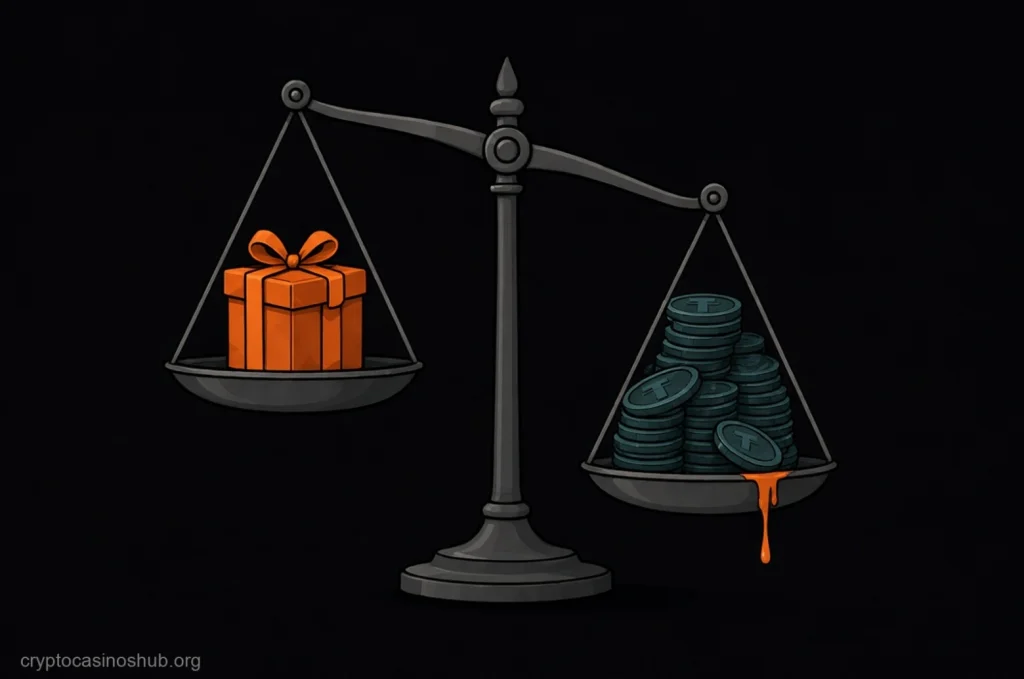
There is one number that tells you whether a casino bonus is worth taking, and it is not the size of the bonus. It is the wagering multiple, measured against the house edge of the games you will clear it on. At the 96% return that most slots pay, the line sits at 25 times. Below it you are being paid to play. Above it you are paying for the privilege of playing with someone else’s chips.
That single sentence covers most of what anyone needs to know about bonuses. The rest of this guide is where the number comes from, what changes it, and how the offers we actually track score against it. There is arithmetic here, but none of it is harder than a supermarket receipt.
Return to player and house edge are the same fact said twice
A slot advertised at 96% RTP returns 96% of everything staked on it, averaged over an enormous number of spins. The other 4% is the house edge. They are two ways of writing one number, and 96% plus 4% is always 100%.
Two things about that average are worth being precise about, because most confusion downstream comes from getting them wrong.
First, it is measured against turnover, not against your deposit. Stake €1 a spin for a thousand spins and you have staked €1,000, even if the same €50 went round and round the whole time. The house edge applies to the €1,000.
Second, the average is drawn from millions of spins, not from your evening. Your session is one sample from a very wide distribution. The 96% is real, it is verified by the studio and the test house, and it describes the machine rather than your night on it.
You can verify a different class of game entirely. House originals like Crash, Mines and Plinko publish a seed and hash chain that lets you check each result after the fact, which is a genuinely different guarantee from a certified random number generator. We explain the mechanics in provably fair, explained and list the operators doing it properly on provably fair casinos. It proves the result was not tampered with. It does not remove the house edge, and it was never meant to.
The only formula you need
Expected cost equals turnover multiplied by house edge.
That is the whole thing. Everything else is working out what the turnover is going to be.
A 35 times requirement on a €100 bonus means €3,500 of turnover. At a 4% edge, the expected cost of producing that turnover is €140. The bonus is worth €100. You are down €40 before anything else happens, on average, in exchange for the entertainment of several thousand spins.
Turn the formula around and you get the break-even multiple. The requirement stops being worth taking when turnover multiplied by edge equals the bonus, which happens at a multiple of one divided by the edge.
| Game RTP | House edge | Break-even wagering multiple |
|---|---|---|
| 98% | 2% | 50x |
| 97% | 3% | 33x |
| 96% | 4% | 25x |
| 95% | 5% | 20x |
| 94% | 6% | 17x |
| 92% | 8% | 12.5x |
Read that table the right way round. A high multiple is only survivable on a high RTP game, and the games with the highest RTP are exactly the ones casinos weight down or exclude. That is not a coincidence, and we come back to it below.
For slots at 96%, which is the realistic default, the answer is 25 times. This is the same arithmetic behind the break-even figure on our no wagering casinos page, and it is worth committing to memory, because it turns a promotions page into a sorting problem you can do in your head.
Bonus only, or deposit plus bonus
Before the multiple means anything, you have to know what it multiplies. There are two conventions and they differ by a factor of two.
Wagering on the bonus alone is the friendlier version. A €100 bonus at 35 times is €3,500.
Wagering on deposit plus bonus is the other one. Deposit €100, receive a €100 match, and the base is €200. At 35 times that is €7,000 of turnover for the same €100 of bonus, which is an effective 70 times on the part you were actually given. Housebets runs its welcome match this way, at 35 times on deposit plus bonus, and the number on the promotions page looks identical to a competitor charging half as much.
Sometimes the terms simply do not say. Mostbet‘s casino welcome states 30 times over 30 days and never specifies the base, which on a €400 bonus is the difference between €12,000 and €24,000 of turnover. When a document is silent, assume the expensive reading and ask support in writing. That, and eight other things worth checking before you deposit, are in the guide to reading casino terms.
What a maximum win cap does to the maths
The formula above quietly assumes you keep whatever you win. Many bonuses cap it.
Vavada‘s clause 9.7 limits winnings from a bonus to ten times the bonus, and Riobet applies the same ten times rule on its welcome package. So a €100 bonus cannot produce more than €1,000, whatever the reels do.
Here is why that matters more than it looks. The expected value of a bonus is an average across every possible outcome, and the outcomes that hold that average up are the rare large wins. Clearing 35 times on a high volatility slot ends with an empty balance most of the time. The reason the average is only slightly negative rather than catastrophic is the small chance of a very big result.
A win cap removes exactly that. It leaves every losing outcome untouched and truncates the winning tail, which means the real expected value of a capped bonus is worse than the break-even table says. A 25 times bonus with no cap sits on the line. A 25 times bonus capped at ten times the bonus sits below it.
Sticky bonuses: the money you can never withdraw
A cashable bonus becomes yours once the wagering is done. A sticky bonus never does. It sits on a separate balance, funds your bets, and is removed at the end. You keep what you won above it, not the bonus itself.
Vavada’s welcome is sticky and says so in clause 9.3. There is nothing wrong with the design, but it changes what the offer is. A sticky €100 is not €100 of value, it is €100 of ammunition, and the value is only whatever survives the wagering after the bonus is taken back out.
One related clause catches people constantly: requesting a withdrawal while a bonus is not fully wagered cancels the bonus. Half-cleared, one impatient click, and the balance goes. If you take a bonus, decide up front that the cashier does not exist until the requirement reads zero.
Why you cannot just clear it on a low edge game
The obvious counterplay to the break-even table is to clear the requirement on blackjack at a half percent edge instead of a slot at four. Casinos worked that out about twenty-five years ago, and there are two mechanisms in the way.
The first is game weighting. Slots count 100%, live tables usually count 10% or nothing. Clearing €1,000 of requirement on a table game weighted at 10% means staking €10,000. At a 0.5% edge that is €50 of expected cost, against €40 on slots at 4%. The weighting is calibrated to make the clever route slightly worse than the obvious one.
The second is exclusion. While a wagering requirement is running at Stake, 47 studios and 678 individual titles are blocked, including 22 of Stake’s own Originals. Low volatility, high return and anything hedgeable comes off the board first.
The most elegant version of this rule, at Stake
Stake replaces game weighting with something cleaner, and it is worth understanding because it shows the whole principle in one line.
Stake’s wagering is weighted by house edge and calibrated to 4%. A game with a 1% edge credits $0.25 of progress per $1 staked. A game at 4% credits the full dollar.
Work through what that does. To clear $1,000 of requirement on the 1% game you must stake $4,000, and 1% of $4,000 is $40. To clear the same $1,000 on a 4% game you stake $1,000, and 4% of that is also $40. The expected cost is identical no matter which game you choose, by construction. The only thing that changes is how many bets it takes, and the low edge route takes four times as many.
Stake publishes this formula openly, which is rarer than it should be. It is also the clearest possible statement of what a wagering requirement is: a fixed toll priced in house edge, with the route left up to you.
Free spins are the same arithmetic wearing a costume
Free spins are advertised as a count, which makes them feel free. Price them like everything else.
Say 250 spins at €0.20 each. That is €50 of stake you did not pay for, and at 96% it returns about €48 in expectation. Now apply the wagering on the winnings. Mostbet attaches 25 times to free spin winnings. Twenty-five times €48 is €1,200 of turnover, and 4% of €1,200 is €48.
The expected cost of clearing the winnings is the winnings. Free spins at 25 times on a 96% slot are worth approximately nothing, which is the 25x rule showing up again in a different outfit. Below 25 times they are worth something real. Above it you are working for the house.
Two details make real free spin offers worse than that. Spin winnings are usually capped, and spins often expire in daily batches. Mostbet releases its 250 spins in five batches of 24 hours each, so a player who misses two evenings loses two fifths of the offer. Genuine no-deposit spins are a different case, because there is no deposit at risk and the downside is only your time. We keep the ones worth claiming on no deposit bonuses.
The offers that survive the arithmetic
Run the formula across the promotions we track and the same two categories come out on top every time. Neither is a welcome bonus.
Cashback at low wagering. Vavada credits 10% of monthly net losses at 5 times. On €100 of cashback that is €500 of turnover and €20 of expected cost, so you keep about €80 of the €100. Casino-X, Fresh and Flagman all run weekly cashback at 5 times, which lands in the same place. Riobet’s weekly cashback runs at 1 time, where you keep about 96%.
Rakeback paid as cash. Duel pays 50% rakeback on slots as withdrawable cash from the first bet, with no wagering attached, and 80% on its own blackjack table. Rakeback rates are normally quoted as a share of the house edge, so a 50% rate on a 4% game returns about 2% of everything you stake. That does not make the game profitable. It halves what an hour costs you, with no requirement to clear and no cap to run into.
Put the categories side by side and the ranking is not close.
| Offer type | Typical terms | Turnover per €100 received | Expected cost at 4% | Roughly what you keep |
|---|---|---|---|---|
| Rakeback as cash | No wagering | €0 | €0 | €100 |
| Cashback at 1x | Riobet weekly | €100 | €4 | €96 |
| Cashback at 5x | Vavada, Fresh, Casino-X, Flagman | €500 | €20 | €80 |
| Match at 25x on bonus | Casino-X tier one | €2,500 | €100 | Break-even |
| Match at 30x on bonus | Ramenbet, Joycasino, BC.Game | €3,000 | €120 | Minus €20 |
| Match at 35x on bonus | Vavada, Riobet | €3,500 | €140 | Minus €40 |
| Match at 40x on bonus | Fresh, Flagman | €4,000 | €160 | Minus €60 |
| Match at 35x on deposit plus bonus | Housebets, on a 100% match | €7,000 | €280 | Minus €180 |
The right hand column is an expectation, not a prediction. It says nothing about what happens to you on a Tuesday. It says what happens on average across thousands of players taking the same offer, which is the only honest way to compare two promotions.
Notice the shape of it. The offers with the biggest headline numbers are at the bottom. The ones nobody advertises on a banner are at the top. Current terms for every operator sit on our crypto bonuses page, and the deposit matches specifically are on welcome bonuses.
Time limits are bet sizing rules in disguise
A requirement with a deadline is a different product from the same requirement without one.
Riobet gives 7 days to clear each step of its welcome package and caps bets at $7 while wagering. Put those two together on a $3,500 requirement and you need $500 of turnover a day at a maximum of $7 a spin, which is at least 72 spins a day, every day, for a week.
That is the real constraint. Not the multiple, the schedule. Anyone who plays twice a week will not finish, and an unfinished requirement usually means the bonus and whatever it built are removed. Before accepting any timed offer, divide the turnover by the days and then by your normal bet, and see whether the answer is a number of spins you will actually play.
Variance: why the average is not your evening
Everything above is an average, and averages describe populations rather than people.
Slot outcomes are heavily skewed. A small number of sessions end far above the average and a large number end at zero, which means the typical result is worse than the mean even when the mean looks survivable. Clearing 35 times on a high volatility slot, the single most likely outcome is an empty balance well before the requirement is finished. The mean is held up by results you probably will not get.
This is also the honest reason maximum bet rules exist. Betting large is the only approach that beats a wagering requirement, because it finishes before the edge has time to grind, and a $7 cap removes that option deliberately. If large bets were bad for the player, they would not need a rule against them.
Two conclusions follow. Judge a bonus by its expected value, because that is the only thing you can compute. Judge a session by whether you can afford to lose the deposit, because that is what usually happens.
How to price any offer in thirty seconds
- Find the multiple and the base. Bonus only, or deposit plus bonus.
- Multiply to get the turnover.
- Multiply the turnover by 4%, or by the real edge if you know the games.
- Compare that number to the bonus. Bigger means the offer costs you money.
- Check for a maximum win cap. If there is one, move your verdict down a step.
- Check the deadline. Divide the turnover by the days and by your usual bet size, and be honest about whether you will play that much.
Do that on three offers and you will stop reading the percentage on the banner, which is the entire point.
Questions about wagering requirements
Is a 500% bonus better than a 100% bonus?
Only if the multiple scales the same way, and it never does. A 100% match at 30 times costs you 20% of the bonus in expectation. A 500% match at 60 times costs 140% of it. The bigger number is normally the more expensive product, and the tiered welcome packages make this worse by putting the eye-catching percentage on the smallest tier. Casino-X advertises 200%, and that rate applies up to €50. The €2,000 tier pays 50%.
What is a good wagering requirement?
Under 25 times on the bonus alone, at 96% RTP, with no maximum win cap and a deadline you can actually meet. Under 10 times is genuinely good and usually means cashback rather than a match. Zero is best, and it exists, mostly at operators that pay rakeback in cash instead of running bonuses at all.
Does the house edge apply to my deposit or to my bets?
To your bets, added up. This is the single most useful idea here. A €100 deposit played through fifteen times is €1,500 of exposure to the edge, which is why long sessions with a small bankroll lose money as reliably as short sessions with a large one.
Can I clear a bonus on a game with a higher RTP?
Sometimes, and it helps less than it looks. Weighting and exclusion lists are built to close that gap, and Stake closes it exactly, by pricing progress in house edge so every route costs the same. Where high RTP does still pay off is in ordinary play with no bonus attached, where nothing is weighted and a 97% game genuinely costs less than a 94% one.
Are provably fair games a better bet mathematically?
Not automatically. Provably fair proves the result was generated honestly and lets you verify it yourself. Plenty of provably fair originals run a 1% edge, which is far better than most slots, but the property that makes them cheap is the edge, not the proof. The two just tend to show up together.
Should I take any bonus at all?
If you were going to deposit and play anyway, a low wagering cashback or a cash rakeback is close to free money and worth taking every time. A 40 times match is worth taking only if you value the extra playing time more than the €60 per €100 it costs, which is a legitimate thing to want as long as you know that is the trade you are making. Bear in mind the second cost too: almost every confiscated balance we have looked into started with a broken bonus rule rather than an accusation of fraud, which is the first thing to check in the payout dispute guide.
Only if the multiple scales the same way, and it never does. A 100% match at 30 times costs you 20% of the bonus in expectation. A 500% match at 60 times costs 140% of it. The bigger number is normally the more expensive product, and the tiered welcome packages make this worse by putting the eye-catching percentage on the smallest tier. Casino-X advertises 200%, and that rate applies up to €50. The €2,000 tier pays 50%.
Under 25 times on the bonus alone, at 96% RTP, with no maximum win cap and a deadline you can actually meet. Under 10 times is genuinely good and usually means cashback rather than a match. Zero is best, and it exists, mostly at operators that pay rakeback in cash instead of running bonuses at all.
To your bets, added up. This is the single most useful idea here. A €100 deposit played through fifteen times is €1,500 of exposure to the edge, which is why long sessions with a small bankroll lose money as reliably as short sessions with a large one.
Sometimes, and it helps less than it looks. Weighting and exclusion lists are built to close that gap, and Stake closes it exactly, by pricing progress in house edge so every route costs the same. Where high RTP does still pay off is in ordinary play with no bonus attached, where nothing is weighted and a 97% game genuinely costs less than a 94% one.
Not automatically. Provably fair proves the result was generated honestly and lets you verify it yourself. Plenty of provably fair originals run a 1% edge, which is far better than most slots, but the property that makes them cheap is the edge, not the proof. The two just tend to show up together.
If you were going to deposit and play anyway, a low wagering cashback or a cash rakeback is close to free money and worth taking every time. A 40 times match is worth taking only if you value the extra playing time more than the €60 per €100 it costs, which is a legitimate thing to want as long as you know that is the trade you are making. Bear in mind the second cost too: almost every confiscated balance we have looked into started with a broken bonus rule rather than an accusation of fraud, which is the first thing to check in the payout dispute guide.
The short version
Turnover multiplied by house edge is the cost. One divided by the house edge is the break-even multiple. At 96% that is 25 times, and it applies identically to deposit matches, free spin winnings and cashback.
Everything a promotions page does is designed to keep you looking at the first number rather than the second. Once you know the second one, the whole category sorts itself, and the offers left at the top are the quiet ones: cashback at 5 times, rakeback in cash, and no bonus at all.
Gambling involves risk and is for adults only. Set a loss limit before you start. Some links here are affiliate links, which has never changed a rating or a measured figure on this site.





Comments
No comments yet. Have your say.